 blog
blog
Average Cost of Window Cleaning: 2026 Pricing Guide
Table of Contents
- Window Cleaning Cost at a Glance
- Factors Affecting Window Cleaning Cost
- Residential Window Cleaning Price Per Window vs. Square Footage
- How to Get an Accurate Window Cleaning Estimate
- Post-Construction and Screen or Track Cleaning Add-Ons
- How Often to Schedule Professional Window Washing
- Frequently Asked Questions
Last Updated: September 18, 2026
Window Cleaning Cost at a Glance
The average cost of window cleaning in the United States depends on your home's size, window count, and how many stories you have. Most homeowners pay a flat fee per pane or an hourly rate, with a minimum service charge on smaller jobs.
At Task Genie, we've completed over 500 jobs across Buckeye and the West Valley. We've seen quotes swing wildly for the same house. Why? Because pricing isn't random. It follows a set of factors you can learn to read.
Below, we'll break down what drives the average cost of window cleaning, how to compare a per-window quote against a square footage quote, and how to get an accurate estimate before you book. But first, here's what most guides get wrong: they quote a single national number and stop there. That number tells you almost nothing about your own home.
| Pricing Factor | Why It Matters | What to Ask |
|---|---|---|
| Number of panes | Main driver of total price | How many panes, not windows? |
| Stories | Higher floors need more gear and care | Do you charge a two-story fee? |
| Interior vs. exterior | Interior adds time and access needs | Is this price inside and out? |
| Window type | French panes and hard water stains take longer | Any surcharge for divided panes? |
| Add-ons | Screens, tracks, and frames add labor | What's included by default? |
| Frequency | Recurring service often costs less per visit | Is there a repeat-customer rate? |
Factors Affecting Window Cleaning Cost
Several factors affect window cleaning cost, and no two homes price the same. The main ones are pane count, height, window style, and how much dirt has built up. A simple ranch home with basic sliding windows sits at the low end. A two-story house with divided panes and years of hard water stains sits at the high end.
Labor is the largest part of any quote. Professional window washing takes time, and time is what you're paying for. What most guides skip is how much each factor moves the number. Here's the mechanism behind each one.
Window Type Complexity and Hard Water Stains
Not all glass cleans the same way. Single-pane sliding windows are fast. French panes, grid windows, and storm windows take far longer because each small section needs individual attention.
The reason is surface area versus edge count. A single large picture window might be 15 square feet of glass with four edges to detail. A divided-light window of the same footprint can have 12 or more individual panes, each with its own frame, corners, and muntins to wipe on both sides. Most crews price divided-light windows per pane rather than per window for exactly this reason, and a common pattern is a per-pane rate that runs meaningfully higher than the rate for an open pane of similar size. If you have a wall of true divided lights, expect the labor to scale with the pane count, not the wall size.
Storm windows add a second layer.
Safety, Insurance, and Eco-Friendly Surcharges
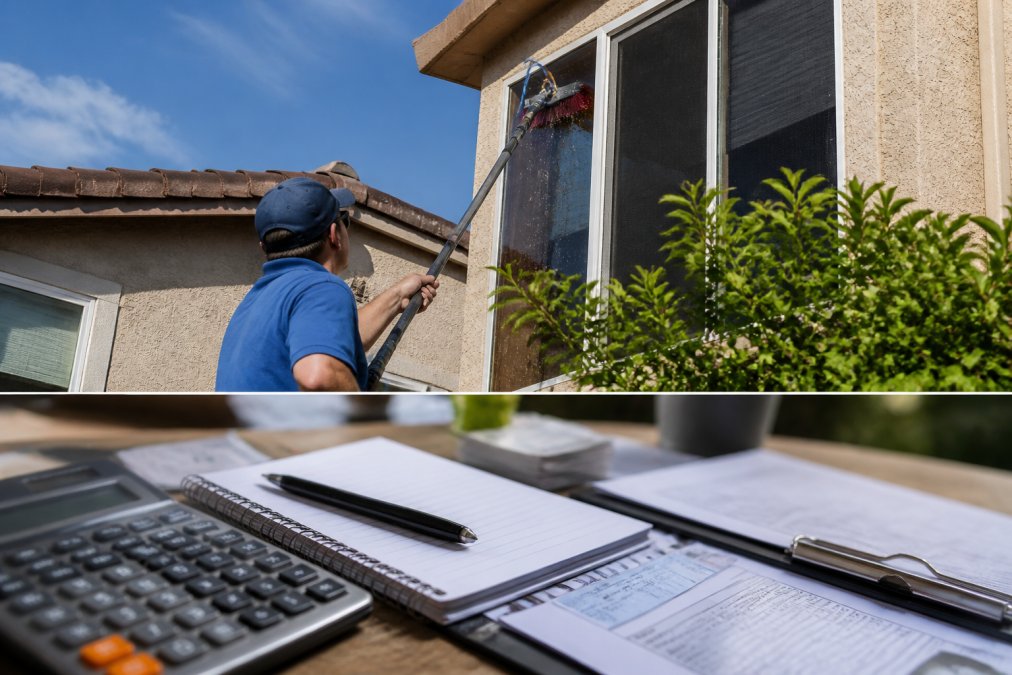
Height adds real risk. Above the first floor, crews need ladders, extension poles, or a water-fed pole system. A water-fed pole with purified water can reach roughly three to four stories from the ground, which is why many companies can clean upper windows without ever setting a ladder against your siding. Above that reach, the job shifts to ladder work or lift equipment, and the price steps up accordingly.
Residential Window Cleaning Price Per Window vs. Square Footage
Residential window cleaning is priced two main ways: per pane or by square footage. Per-pane pricing is the most common for homes because it's easy to count and easy to quote. Square footage pricing shows up more on large commercial glass or big custom homes.
Here's how to think about each:
- Cost per pane: You pay a set rate for each pane of glass. Simple, predictable, and easy to compare across quotes.
- Square footage pricing: You pay based on total glass area. This favors homes with large picture windows.
- Hourly rate: Some companies charge by the hour plus a minimum service charge.
- Flat fee: A single price for the whole job, usually after an on-site look.
Interior vs. Exterior Cleaning Costs
Exterior-only cleaning is the cheaper option and the most common request. Crews work from outside, move fast, and don't need to enter your home.
How to Get an Accurate Window Cleaning Estimate
Getting an accurate window cleaning estimate comes down to giving the company the right information. Vague requests get vague quotes, and vague quotes lead to surprise charges on the day of service.
The Four Ways a Quote Is Built
- Per pane: You pay a set rate for each pane of glass. Simple, predictable, and easy to compare across quotes. Best for homes with standard windows.
- Per window: You pay per opening, regardless of how many panes it holds. This can look cheaper than per-pane pricing on divided-light windows, so always ask which unit the rate applies to.
- Square footage: You pay based on total glass area. This favors homes with large picture windows and is more common on big custom homes and commercial glass.
- Flat fee: A single price for the whole job, usually after an on-site look or photos. The most accurate, but only if the scope is written down.
Ask which method a company uses. A per-pane quote and a square footage quote for the same house can look very different, even when the final price is close. The number that matters is the total, not the unit rate.
What Separates a Firm Quote From a Guess
A firm quote names the scope. It says how many panes, whether interior is included, whether screens and tracks are in or out, and whether hard water removal is part of the job or an add-on. If any of those are missing, the price is an estimate, not a quote.
Use this checklist before you request a service quote:
- Count your panes, not your windows. A single window can hold two or more panes.
- Note how many stories your home has.
- Decide if you want interior, exterior, or both.
- List any add-ons: screens, tracks, frames, hard water stain removal.
- Mention any window type that takes extra care, like French panes or storm windows.
- Ask if the quote is a flat fee or an estimate that can change.
- Confirm the company carries liability insurance and ask for a certificate.
- Ask about the minimum service charge for small jobs.
- Ask whether the price is locked once you accept, or subject to an on-site adjustment.
Why the Same House Gets Three Different Prices
When quotes diverge, it's almost never random. The gap usually comes from one of four places: what's included (interior, screens, tracks), how the provider counts panes, whether the provider is insured and paying workers legally, and how busy their schedule is. A low quote that skips screens and tracks isn't a cheaper job. It's a smaller job. Compare scope first, price second.
Post-Construction and Screen or Track Cleaning Add-Ons
Add-on services are where quotes quietly grow, so it pays to know what each one involves. Screen cleaning, track cleaning, and frame wiping are the most common extras. Post-construction cleaning is a bigger job entirely.
- Screen cleaning: Removes dust and pollen so air flows clean.
- Track cleaning: Clears grit that damages seals and hardware.
- Frame and sill wiping: Finishes the job so the whole window looks clean.
- Hard water stain removal: Restores glass clouded by mineral buildup.
- Glass restoration: For badly etched glass that normal cleaning can't fix.
How Often to Schedule Professional Window Washing
Most homes do well with professional window washing two to four times a year. The right maintenance schedule depends on your climate, nearby trees, and how much dust your area sees. Homes near construction or open desert typically need more frequent visits.
Frequently Asked Questions
How much should I pay a window cleaner?
The average cost of window cleaning varies with pane count, story height, and whether interior cleaning is included. Homes with hard water stains, skylights, or post-construction debris may sit at the higher end. Always request a written service estimate that lists pane count and any add-ons before you book.
Does the number of window panes affect the cleaning cost?
Yes. Most companies price by the pane, so a home with 30 panes costs more than one with 12. Residential window cleaning price per window typically falls in a modest range per pane, but that rate climbs for French panes, storm windows, or panes that need hard water stain removal. Ask whether the quote counts individual panes or groups them by window frame.
Do window cleaners do inside and out?
Many do, but interior and exterior cleaning are often quoted separately. Exterior-only service is the cheaper option because it skips furniture moving, floor protection, and interior sill wiping. If you want both sides done, say so upfront so the company can factor interior labor costs, window tracks, and screens into the service quote.
How often should you have your windows professionally cleaned?
Twice a year works for most homes, usually in spring and fall. Properties near dust, pollen, or construction may need quarterly service to prevent hard water stains and mineral buildup. A consistent maintenance schedule keeps glass clearer and often lowers the per-visit price compared to one-off cleanings.