 how-to
Maintaining Pool Water Chemistry After Heavy Rain
Table of Contents
- What Heavy Rain Does to Pool Water Chemistry
- Step 1: Remove Debris and Clear Skimmer and Pump Baskets
- Step 2: Test pH and Total Alkalinity After Rain
- Pool pH After Rain: Adjusting to the 7.4-7.6 Range
- Pool Alkalinity After Rain: Restoring the 80-120 ppm Buffer
- Shocking a Pool After Heavy Rain: Dosage and Timing
- Cloudy Pool Water After Rain: Causes and Fixes
- Lowering the Water Level and Runoff Safety
- Frequently Asked Questions
Last Updated: October 12, 2026
What Heavy Rain Does to Pool Water Chemistry
Heavy rain doesn't just top off your pool, it resets the water. Rainwater is slightly acidic and carries almost no sanitizer, so a few inches dilutes your chlorine, drags pH down, and washes in dirt, pollen, and lawn runoff.
That's the core problem with maintaining pool water chemistry after heavy rain: the storm changes water level, chemical balance, and debris load at once.
Most guides tell you to dump in chemicals the moment the rain stops. But adding anything before you test is guesswork.
The pattern for post-storm pool recovery is always the same: test first, then treat.
What changed in your water? Three things:
- Chlorine dropped. Rainwater has no free chlorine, so it dilutes what you had.
- pH drifted. Rain is mildly acidic and pulls pH down.
- Total alkalinity thinned out. The buffer that holds pH steady got watered down.
Below: the exact order to fix all three, plus handling an overfilled pool and when it's safe to swim.
Step 1: Remove Debris and Clear Skimmer and Pump Baskets
Start with physical cleanup before touching a chemical. Debris keeps breaking down and eating your chlorine, so clearing it first means your chemicals last.
Skim leaves, twigs, and grass clippings off the surface, then check the skimmer basket at the pool's edge and the pump basket near the equipment pad. Both fill fast after a storm.
A clogged basket chokes water flow, so your filter and pump work harder and clean less. A packed pump basket can make the pump run dry and overheat.
What most people miss: leaves that sank to the bottom. Vacuum those too, or they'll keep decaying and feeding algae.
- Skim the surface first
- Empty the skimmer basket
- Empty the pump basket
- Vacuum settled debris off the floor
- Check the filter pressure gauge
If pressure reads high, backwash or clean the filter before moving on. The CDC guidance on healthy swimming and pool water notes that keeping water clear and properly filtered is one of the basics of safe pool operation.
Once the water is moving freely again, you're ready to test.
Step 2: Test pH and Total Alkalinity After Rain
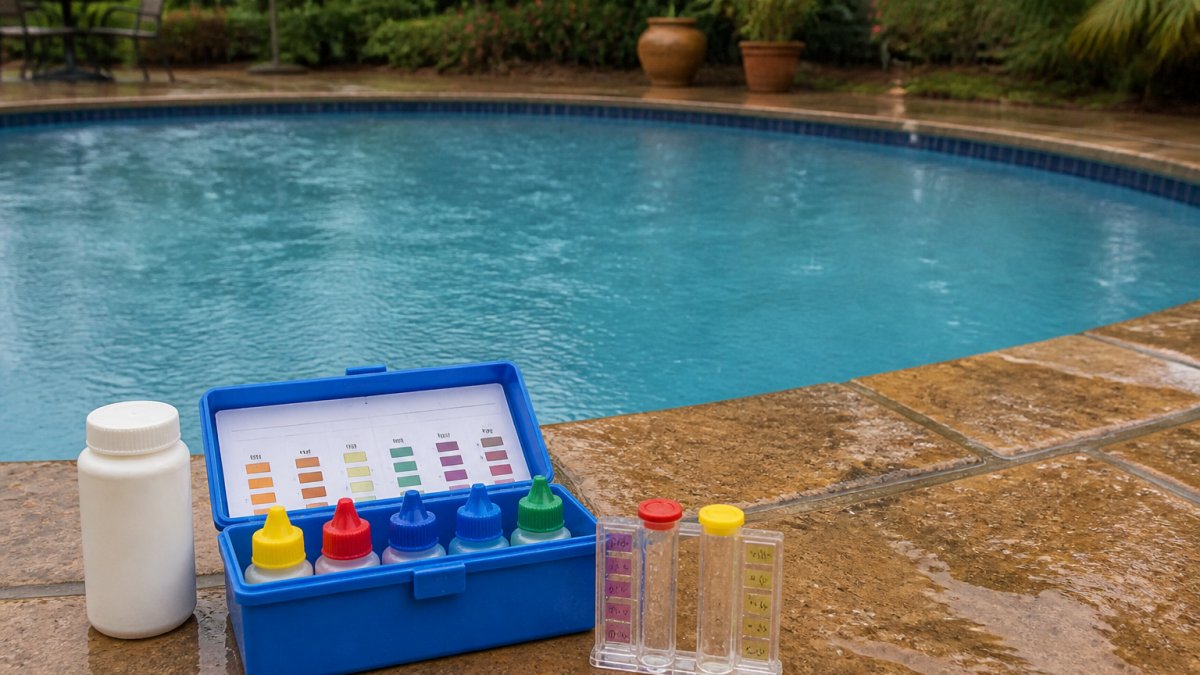
Testing comes before any adjustment. A test kit or strips give you the two numbers that matter most after a storm: pH and total alkalinity.
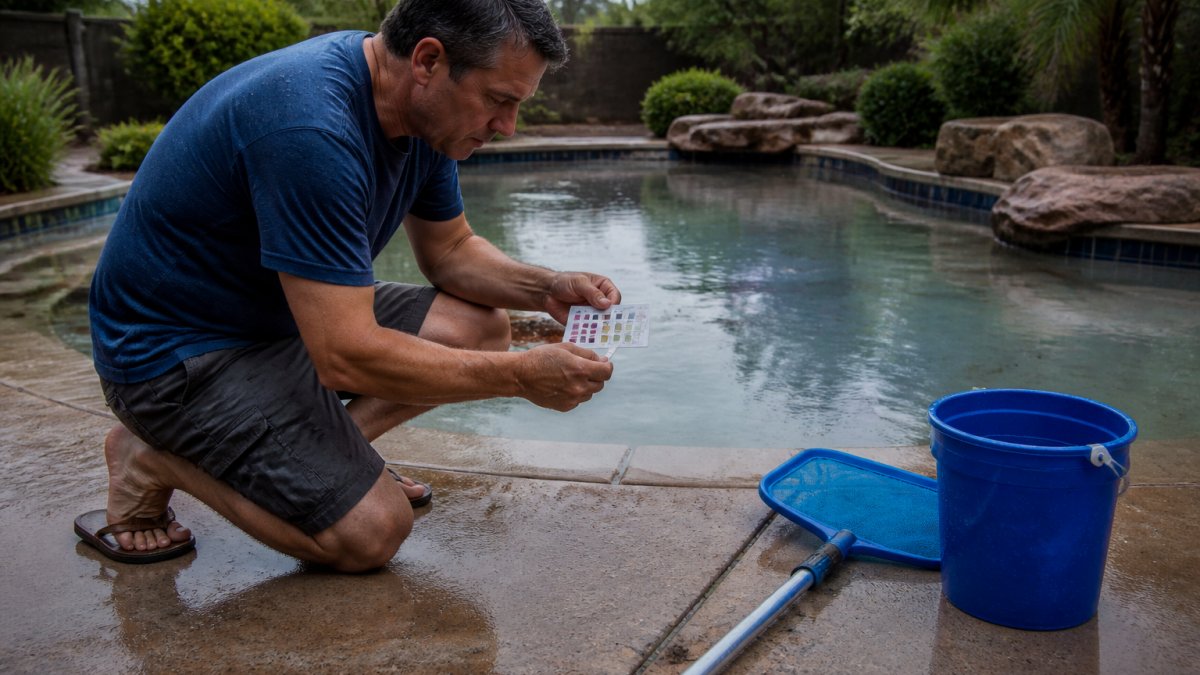
Dip the strip or collect a sample from elbow depth, away from the return jets, and read it in good light. Write both numbers down before changing anything.
Pool water chemistry is the balance of pH, alkalinity, sanitizer, and hardness. When one number moves, the others often follow.
Here's the sequence that works:
- Test pH and total alkalinity first
- Adjust alkalinity before pH
- Test and restore chlorine
- Retest everything the next day
Why alkalinity before pH? Alkalinity is the buffer that holds pH steady. Fix the buffer first, and your pH adjustment sticks instead of bouncing back.
Pool pH After Rain: Adjusting to the 7.4-7.6 Range
The target for pH is 7.4 to 7.6. Rain usually pushes pH down, so most post-storm pools need a lift.
If pH reads below 7.4, raise it with a pH increaser at the label dose for your pool size. Add it in steps, then retest after a few hours of circulation.
If pH reads above 7.6, lower it with a pH decreaser. High pH makes chlorine sluggish, so it stops killing contaminants well.
A common mistake is chasing pH without fixing alkalinity first. If alkalinity is low, pH swings right back out of range. Fix the buffer, then fine-tune pH.
- Below 7.4: raise pH
- 7.4 to 7.6: leave it alone
- Above 7.6: lower pH
Run the pump while you adjust so the chemical mixes. Retest before you add a second dose.
Pool Alkalinity After Rain: Restoring the 80-120 ppm Buffer
Total alkalinity should sit between 80 and 120 ppm for plaster, vinyl, and fiberglass pools.
This is the step most guides gloss over, so here's the precise sequence.
1. Read the number before you dose. Test total alkalinity first, then pH, and write both down.
2. Calculate the gap. Subtract your reading from your target.
**3.
4. Add in steps, not all at once. Broadcast it across the deep end or pour it slowly near a return jet with the pump running.
5. Retest before the second dose. If you're still short of 80 ppm, add the remainder; if you're in range, stop.
A few things that trip people up:
- Don't chase a perfect number. Anywhere from 80 to 120 ppm is fine, aim for the middle and leave it.
- Alkalinity and pH move together. Raising alkalinity nudges pH up, usually helpful after rain. But if pH was already high, fix pH first or you'll overshoot.
- Rain isn't the only diluter. Backwashing, splash-out, and topping off thin the buffer too. If alkalinity keeps dropping, look at your water loss, not just the weather.
- Saltwater pools follow the same rule. The salt cell doesn't produce alkalinity, so a saltwater pool after heavy rain needs the same sodium bicarbonate correction as a chlorine pool.
Once alkalinity holds between 80 and 120 ppm, your pH adjustment will stick, that's when you move on to sanitizer.
Shocking a Pool After Heavy Rain: Dosage and Timing
Shocking a pool after heavy rain restores the sanitizer the storm wiped out. Rainwater carries no free chlorine, so even a balanced pool needs a boost.
Wait until debris is cleared and alkalinity is back in range. Shocking into unbalanced water wastes the product.
Follow the shock label for your pool volume, using the higher end of the dose after heavy rain or visible contamination. Run the pump to circulate, and keep swimmers out until free chlorine drops back to a safe range.
- Shock after debris removal and alkalinity correction
- Use the label dose for your pool size
- Run the pump to circulate
- Keep swimmers out until chlorine settles
If runoff, flooding, or sewage may have entered the pool, treat it as contaminated. The EPA information on recreational water and contamination advises against swimming when water may be contaminated, and heavy runoff is exactly that situation.
Cloudy Pool Water After Rain: Causes and Fixes
Cloudy pool water after rain usually comes down to dead algae, fine debris the filter hasn't caught, or unbalanced chemistry.
Fix the cause, not the symptom. Test the water and correct pH, alkalinity, and chlorine in that order. Then let the filter do its job.
Run the pump longer than usual and clean or backwash the filter as pressure rises. If it stays cloudy after chemistry is balanced and the filter is clean, the filter may be undersized or the debris load heavy.
| Symptom | Likely Cause | Fix |
|---|---|---|
| Cloudy white water | Low chlorine, dead algae | Shock, then run filter |
| Green tint | Algae bloom starting | Brush, shock, filter |
| Cloudy after debris | Fine particles | Vacuum, clean filter |
| Won't clear up | Poor circulation | Run pump longer |
Brush the walls and floor before shocking. Algae clings to surfaces, and brushing exposes it to chlorine so it actually dies.
Lowering the Water Level and Runoff Safety
An overfilled pool needs to come back to mid-skimmer level, where the skimmer pulls surface water in efficiently.
How to lower the water safely
Two practical options, suited to different situations:
- Waste mode on the filter valve. Set the multiport valve to Waste, which bypasses the filter and sends water out the discharge line. It's fast and uses equipment you already have, but it dumps water you may have just balanced, so do it before adding chemicals.
- A submersible pump. Drop it in the deep end and run a hose to a safe discharge point. Slower, but you can stop precisely at mid-skimmer without disturbing the filter. Better if your valve is stiff, you're unsure of the plumbing route, or you want to leave the pool running while you drain.
Either way, watch the level and stop at mid-skimmer. Never drain the whole pool.
Why partial draining matters
An empty or nearly empty pool is a structural risk.
A safe rule: never drop below mid-skimmer for routine post-storm correction. Going lower for a repair is a job for a pool professional who can assess your water table and shell type first.
Where the water goes
- Never pump pool water onto a neighbor's property or into a storm drain.
- Check local rules before draining, some areas restrict where pool water can go and some require dechlorination first.
- Keep kids and pets away from the pump and wet equipment pad, and never let the pump run dry.
Runoff and contamination
Runoff is the bigger concern after a major storm.
Treat the water as contaminated, and keep everyone out, if any of these happened:
- Floodwater or sewage visibly entered the pool
- The pool sits near a farm, golf course, or industrial site that could have released chemicals
- The water is discolored, oily, or has an unusual odor after the storm
- You can't account for what ran off into the pool
In those cases, don't just shock and swim. A single shock dose may not oxidize a heavy contaminant load, and oils, pesticides, and sewage aren't fixed by chlorine alone.
For ordinary rain runoff with no flooding, the recovery is the same sequence: clear debris, test, fix alkalinity, adjust pH, then shock.
When it's safe to get back in
Don't rely on a general 'shock and wait' instruction. Use measurable criteria:
- Free chlorine is back in the normal range and holding steady on two tests several hours apart
- pH is between 7.4 and 7.6
- Total alkalinity is between 80 and 120 ppm
- The water is clear enough to see the main drain from the deck
- No visible debris, film, or odor remains
If all five are true, the water is ready. If any one isn't, keep correcting in order, alkalinity, then pH, then sanitizer, and retest the next day.
Frequently Asked Questions
What should I test in my pool water after a storm?
Test pH, total alkalinity, free chlorine, and calcium hardness before adjusting anything. Rain dilutes sanitizer, shifts pH, and can wash in runoff that changes alkalinity. Start with a test kit or strips, record the numbers, then treat in this order: alkalinity first, then pH, then chlorine. Skipping the test phase means you may add chemicals you did not need, which wastes money and can make the water harder to balance.
Does rainwater raise or lower pool alkalinity?
Rainwater is slightly acidic and has near-zero alkalinity, so it usually lowers total alkalinity when it dilutes pool water. Heavy storms that dump several inches can drop alkalinity below the 80-120 ppm target range. Low alkalinity makes pH bounce around, so raise it with sodium bicarbonate (baking soda) before adjusting pH. Retest 24 hours later, because alkalinity shifts take time to register accurately.
Should I shock my pool after heavy rain?
Yes, in most cases. Heavy rain washes in organic debris, runoff, and contaminants that consume free chlorine. A shock dose of granular or liquid chlorine restores the sanitizer level and breaks down chloramines. Use a shock product labeled for your pool type, add it at dusk, and run the pump overnight. Retest free chlorine the next morning and confirm it holds at 1-3 ppm before anyone swims.
How long should I run the pool pump after heavy rain?
Run the pump continuously for at least 24 hours after a heavy storm, and longer if the water is cloudy or debris-heavy. Continuous circulation pushes contaminated water through the filter and helps chemicals distribute evenly. Check the skimmer and pump baskets every few hours during that window, because leaves and runoff debris clog them fast and reduce water flow. Clean baskets restore circulation and speed up clearing.