 ultimate-guide
Commercial Paver Sealing: Expert Guide for 2026
Table of Contents
- Why Commercial Paver Sealing Matters for Your Property
- Commercial Grade Paver Sealer Types: Which One Fits Your Property?
- The Expert Paver Sealing Process for Commercial Properties
- Cost of Commercial Paver Sealing: What Property Managers Should Budget
- Commercial Paver Maintenance Schedule: Protecting Your Investment
- Compliance, Safety, and Sustainability in Commercial Paver Care
- Conclusion: Take the Next Step for Your Commercial Pavers
- Frequently Asked Questions
Last Updated: September 20, 2026
Why Commercial Paver Sealing Matters for Your Property
Commercial paver sealing applies a protective coating to interlocking pavers that shields against stains, moisture, and UV damage while stabilizing joints, protecting both appearance and structural integrity at once.
Walk any busy commercial property and you can read its maintenance history in the pavement: pavers faded chalky pink, joint sand washed out leaving wobbly stones and weed lines, oil spots soaked in permanently.
At Task Genie, we have completed more than 500 property care jobs, and the pattern is consistent: pavers sealed on a schedule outlast unsealed pavers by years, not months. Sealing also delivers the fastest curb appeal improvement per dollar of any exterior maintenance task.
Commercial Grade Paver Sealer Types: Which One Fits Your Property?
The right commercial-grade paver sealer depends on how the surface is used. High-traffic walkways and drive lanes need different protection than a decorative courtyard, and the wrong chemistry can mean a slick surface or a coating that peels within a season.
Penetrating Sealers
A penetrating sealer soaks into the paver rather than sitting on top of it, reacting with minerals in the concrete or clay to block water and oil absorption while leaving texture unchanged.
This is the default choice where slip resistance matters. With no film on the surface, penetrating sealers will not peel, yellow under UV, or create a glossy sheen that shows every scuff. They are breathable, so trapped moisture escapes instead of pushing the coating off from underneath.
The trade-off: they do not deepen color like a film-forming product and need reapplication more often, usually an acceptable exchange for safety and low maintenance risk.
Film-Forming Sealers
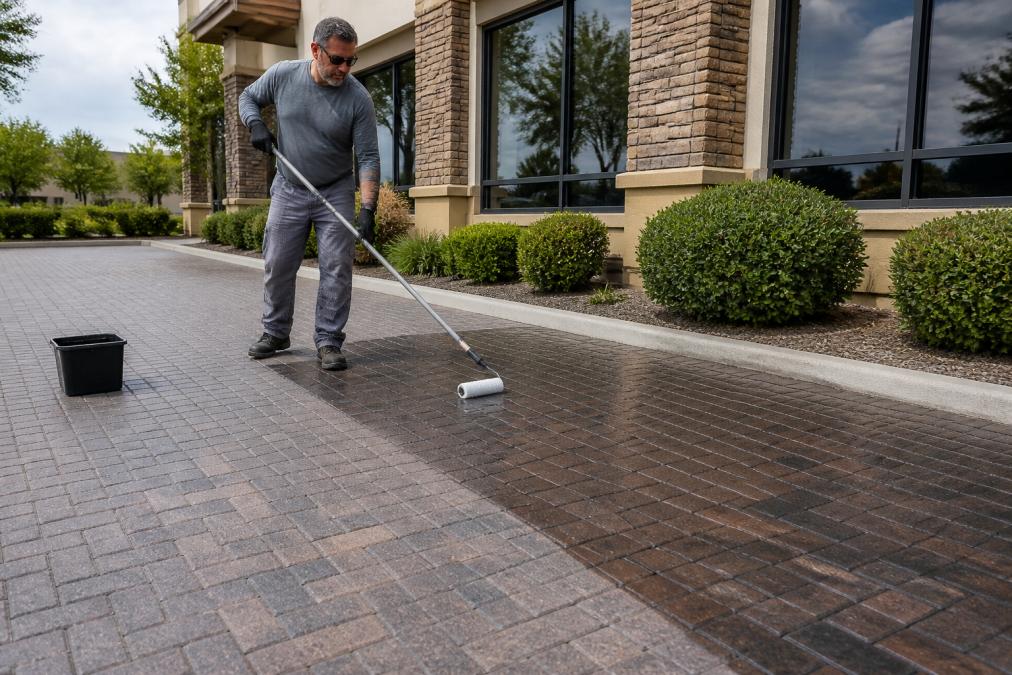
A film-forming sealer cures into a thin protective layer on top of the pavers, producing the "wet look" or high-gloss finish many business owners want for entryways and outdoor dining areas.
The film is both its strength and weakness: it provides excellent stain resistance and UV protection because the coating takes the abuse instead of the paver, and it locks joint sand in place for joint stabilization and weed suppression.
The catch: film-forming sealers require careful surface preparation. If pavers are damp or the previous coating incompatible, the film will cloud, bubble, or peel, and on a commercial property, a peeling sealer is worse than none.
| Sealer Type | Finish | Best For | Watch Out For |
|---|---|---|---|
| Penetrating | Natural, matte | High-traffic walkways, ramps, pool decks | Needs more frequent reapplication |
| Film-forming (acrylic) | Gloss or wet look | Entryways, courtyards, low-traffic zones | Can peel if surface is prepped poorly |
| Film-forming (polyurethane) | Satin to high gloss | Heavy commercial use, restaurant patios | Higher material cost, longer cure time |
The Expert Paver Sealing Process for Commercial Properties
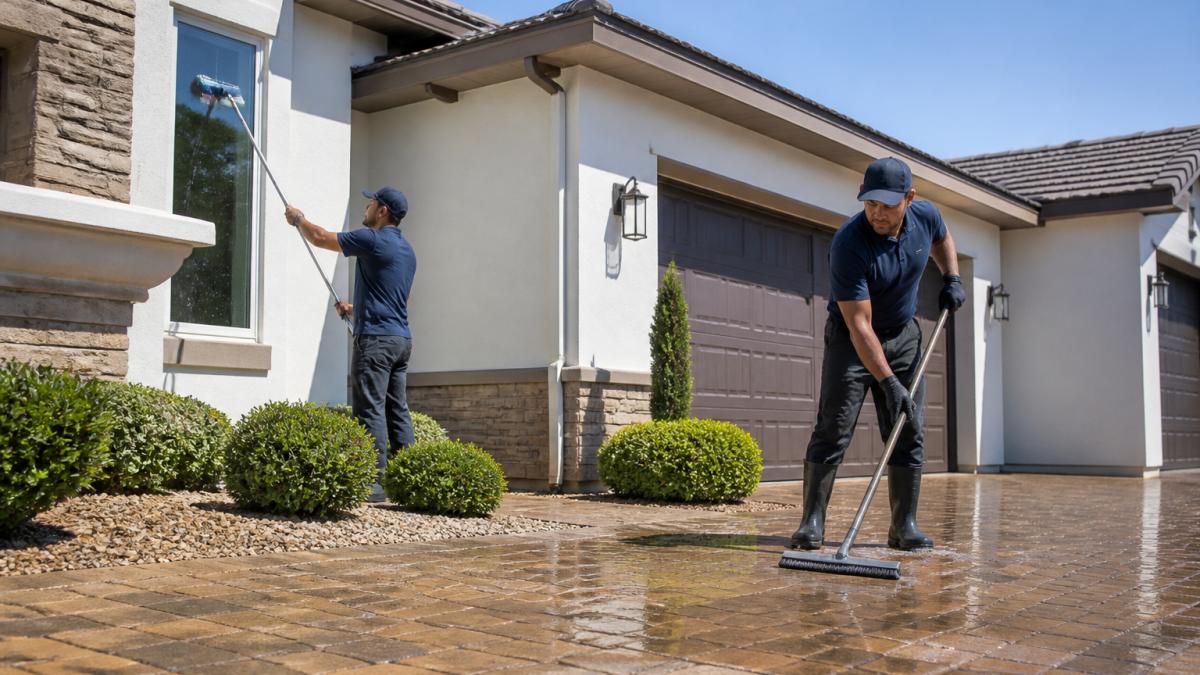
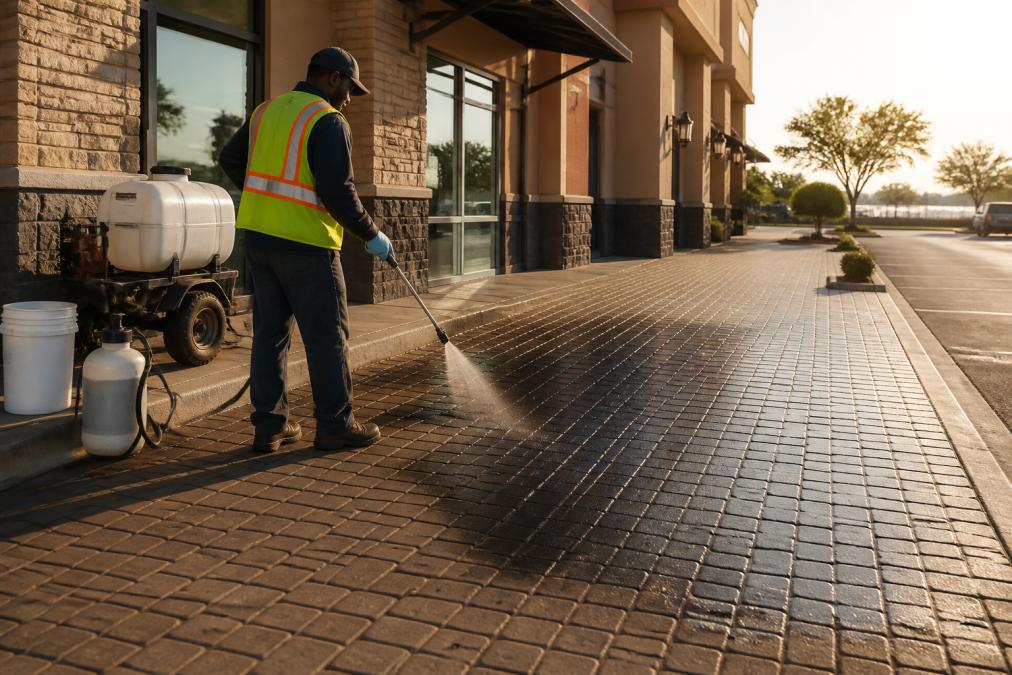
Expert paver sealing for commercial properties follows a fixed sequence: assess, clean, repair, dry, seal, and cure. Skipping or rushing any step is the most common reason a job fails within a year.
Cost of Commercial Paver Sealing: What Property Managers Should Budget
The cost of commercial paver sealing varies with square footage, paver condition, sealer type, and site access. Pricing is quoted per project after an on-site assessment; any phone figure given without seeing the property is a rough placeholder.
- Total square footage. Larger surfaces cost less per square foot because setup and travel spread across more area.
- Condition of the pavers. Heavy staining, failed prior coatings, or widespread efflorescence removal adds labor hours.
- Sealer selection. Penetrating sealers and premium film-forming products sit at different price points.
- Joint work required. Washed-out polymeric sand across a large area adds material and time.
- Access and scheduling. Night or weekend work to avoid disrupting business carries a premium.
- Number of coats. High-traffic zones often need a second coat for adequate durability.
The Long-Term ROI Case Most Contractors Never Make
Most sealing quotes are a single line item, making it easy to compare bids on price alone. That framing hides the number that matters: the cost of not sealing, spread across the life of the pavement.
| Scenario | What Happens | Cost Pattern |
|---|---|---|
| Sealed on schedule | Cleaning, spot repairs, and resealing every 2-3 years | Predictable, recurring, low per-year cost |
| Unsealed | Joint sand loss, weed intrusion, staining, UV fading, then localized paver and base failure | Low for years, then a large restoration invoice |
How to Compare Bids Without Getting Burned
When two quotes for the same property differ widely, the gap is almost always scope, not margin. Ask each bidder to state, in writing:
- Whether old failing sealer will be stripped, and how
- Whether joints will be re-sanded with polymeric sand or left as-is
- How many coats are included, and at what spread rate
- What surface moisture threshold must be met before application
- What the cure window is, and who is responsible for keeping traffic off the surface
- What the workmanship warranty covers, and for how long
Commercial Paver Maintenance Schedule: Protecting Your Investment
A commercial paver maintenance schedule is the difference between a hardscape that lasts 15 years and one that needs restoration at year six. This is a recommended schedule for commercial properties, adjusted for traffic volume.
| Frequency | Task | Why It Matters |
|---|---|---|
| Weekly | Blow or sweep debris from high-traffic areas | Prevents abrasion and keeps joints clear |
| Monthly | Spot-treat oil and food stains | Fresh stains lift; set stains become permanent |
| Quarterly | Inspect joints for sand loss and weed growth | Catches joint failure before pavers shift |
| Annually | Deep cleaning and pressure washing | Removes embedded dirt and biological growth |
| Every 2-3 years | Reapply sealer | Restores the moisture barrier and UV protection |
| As needed | Re-sanding and efflorescence removal | Maintains joint stabilization and appearance |
One Schedule Does Not Fit Every Commercial Property
The table above is a baseline; property type determines where you compress the cycle and where you can stretch it.
Slip Resistance Is a Compliance Item, Not a Preference
On any commercial property with an accessible route, the surface must remain stable, firm, and slip resistant. A high-gloss film-forming sealer on a walkway can reduce traction, especially when wet, a liability exposure as well as a compliance issue.
Preventative Maintenance Beats Reactive Repair
Two adjustments matter for commercial sites. First, high-traffic areas such as entryways, drive lanes, and dumpster pads should be inspected on a shorter cycle because they wear first. Second, preventative maintenance costs far less than reactive repair: catching a washed-out joint line in month three is a sanding job; catching it in year two is a paver replacement job.
Compliance, Safety, and Sustainability in Commercial Paver Care
The ADA Standards for Accessible Design set the requirements for accessible surfaces, and the U.S. Environmental Protection Agency maintains guidance on the runoff and disposal considerations that apply when cleaning and sealing products are used on a commercial site. Your contractor should be able to tell you how wash water is contained and where it goes.
Conclusion: Take the Next Step for Your Commercial Pavers
Commercial pavers are one of the most expensive surfaces on your property, and one of the most neglected. The gap between a sealed, scheduled hardscape and an unmaintained one shows up in curb appeal first and repair invoices second.
Frequently Asked Questions
What do professionals use to seal commercial pavers?
Professionals use commercial-grade sealers, which are either penetrating or film-forming. Penetrating sealers soak into the paver to block moisture and stains from within, while film-forming sealers create a protective topcoat that adds shine and slip resistance. The choice depends on your paver type, traffic, and desired look. Expert contractors assess your property to recommend the best option.
How much does commercial paver sealing cost?
The cost of commercial paver sealing varies based on square footage, paver condition, sealer type, and site preparation needs. Most companies provide a custom quote after an on-site assessment. While a precise figure depends on your property, investing in professional sealing can extend paver lifespan and reduce long-term repair expenses. Contact Task Genie for a free quote tailored to your commercial space.
How often should commercial pavers be resealed?
Most commercial pavers need resealing every 2 to 3 years, but high-traffic areas may require it more frequently. A commercial paver maintenance schedule should include annual inspections to check for wear, efflorescence, or joint sand loss. Resealing when the sealer shows signs of dullness or water no longer beads up ensures continuous protection and keeps your property looking sharp.
Does sealing pavers prevent weed growth?
Sealing pavers helps prevent weed growth by stabilizing joint sand and reducing the gaps where seeds can settle. Polymeric sand, often used with sealing, hardens in the joints to block weeds and insects. However, sealing alone won't stop all weeds; regular maintenance like re-sanding and cleaning is still necessary. A professional sealing service can apply polymeric sand and sealer together for best results.