 ultimate-guide
How to Choose a Pool Cleaning Company in 2026
Last Updated: October 25, 2026
Quick Summary
Choose a pool cleaning company by verifying licensing and insurance in writing, confirming local experience and references, reading reviews across multiple platforms, getting the service schedule in writing, requesting an itemized quote that separates routine service from repairs, and confirming a written satisfaction policy in the contract.
- Ask for a certificate of insurance with current general liability coverage and confirm it with the insurer.
- Request an itemized quote separating labor, chemicals, equipment checks, and travel or seasonal fees.
- Weekly service suits most residential pools because water chemistry drifts within days.
- Use a visit checklist covering chemistry testing, skimming, brushing, vacuuming, baskets, filter, and inspection.
- Avoid contracts with auto-renewal and steep early-termination fees; get the cancellation window in writing.
Table of Contents
- What a Pool Cleaning Company Actually Does
- How to Choose a Pool Cleaning Company: 6 Selection Criteria
- Questions to Ask a Pool Cleaning Company Before You Sign
- What Pool Service Cost Really Covers
- Weekly Pool Cleaning Service vs. One-Time and Seasonal Plans
- A Pool Cleaning Checklist to Judge Every Service Visit
- Red Flags, Contracts, and Service Accountability
- Get a Free Quote and Lock In Your Service Schedule
- Frequently Asked Questions
What a Pool Cleaning Company Actually Does
The U.S. swimming pool cleaning services industry is estimated at $8.8 billion in 2026, according to IBISWorld's industry data, which tells you how many homeowners have decided that hands-on pool care is a job worth outsourcing. At Task Genie, we've watched that shift up close: a pool cleaning company is a service business that visits your property on a set schedule to keep water balanced, surfaces clear, and equipment healthy, rather than a repair shop you call only when something breaks. That distinction matters more than most buyers realize.
Routine Service Tasks vs. Repairs
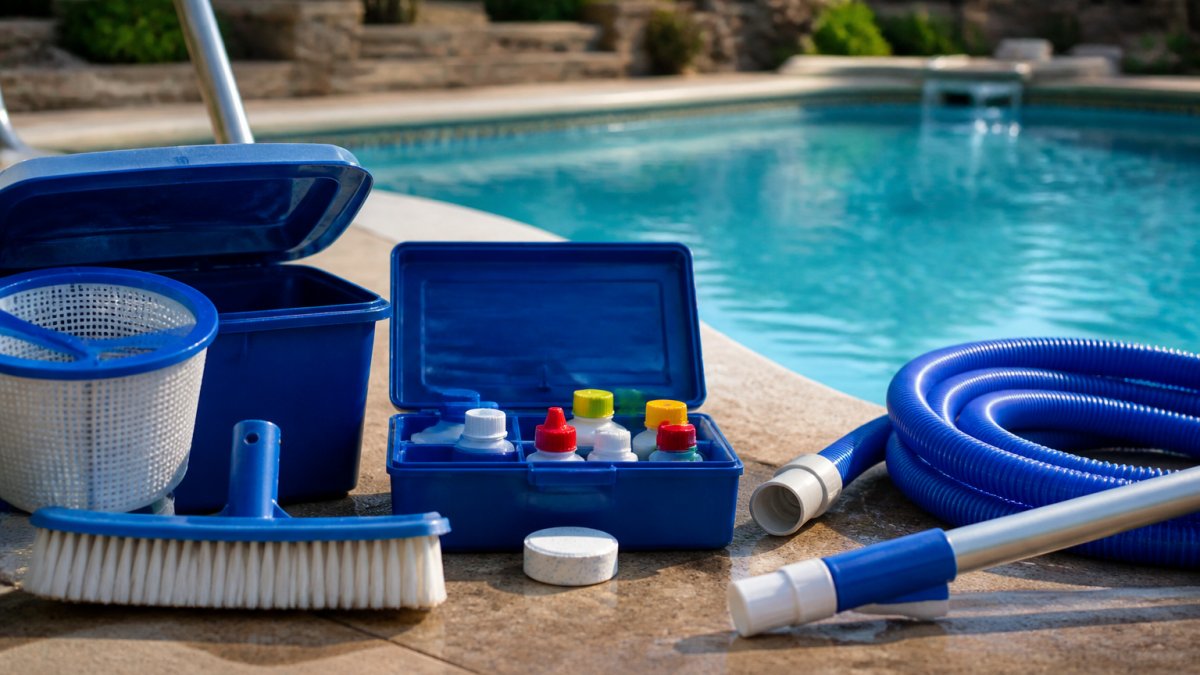
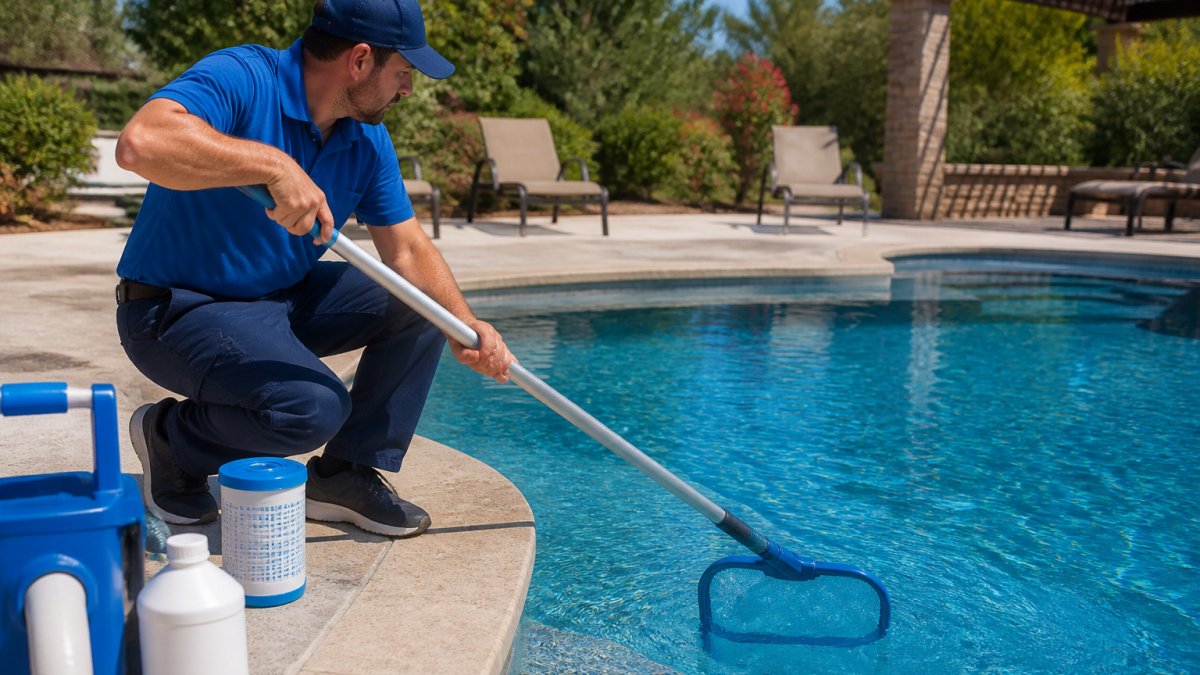
Routine service covers recurring work: skimming debris, brushing walls and tile lines, vacuuming the floor, emptying baskets, testing chemistry, and inspecting equipment. Repairs are separate: pump failures, heater problems, filter replacements, and leak detection. A good provider flags repair issues during routine visits but doesn't quietly fold them into your bill.
If you want to see how a full-service offering is structured before you start calling around, our services lay out what professional pool cleaning includes.
How to Choose a Pool Cleaning Company: 6 Selection Criteria
Choosing a pool cleaning company comes down to six checks: verified licensing and insurance, documented experience, real customer reviews, a clear service schedule, transparent pricing, and a written accountability policy. Most homeowners skip straight to price, exactly how they end up with a cheap company that disappears mid-season.
Here's the framework we'd use:
- Verify licensing and insurance in writing, not verbally.
- Confirm years in business and local references you can actually call.
- Read reviews across multiple platforms, not just the company's own site.
- Get the service schedule in writing (weekly, biweekly, or monthly).
- Request an itemized quote that separates routine service from repairs.
- Ask what happens when you're not satisfied, and get the answer in the contract.
That last point separates serious operators from the rest. The other five are table stakes.
Experience, Reputation, and Real Customer Reviews
A company that has serviced hundreds of local pools has already encountered your pool's quirks: hard water, heavy debris loads after monsoon season, older equipment that needs a gentle touch. Ask for the number of pools currently under contract, not just years in business, then check reviews on Google, Yelp, and the Better Business Bureau for patterns in complaints rather than one-off bad ratings. You can also see real results from completed pool cleaning projects.
Licensing, Insurance, and Technician Qualifications
Licensing and insurance are non-negotiable. Ask for a certificate of insurance showing current general liability coverage, and check your state licensing board directly rather than taking a salesperson's word for it. Ask whether technicians are trained on chemical handling and equipment diagnostics, an uninsured technician injured on your property becomes your liability problem fast.
Questions to Ask a Pool Cleaning Company Before You Sign
The right questions to ask a pool cleaning company fall into four buckets: scope, schedule, cost, and accountability. Ask what's included in a standard visit, how often they service your pool, what triggers an extra charge, and what their satisfaction policy says. Vague answers signal you to keep shopping.
Specific questions worth asking:
- What exactly happens on each visit, and will I get a service report?
- Are chemicals included in the quoted price or billed separately?
- How do you handle weeks when I'm traveling or the pool is covered?
Write the answers down. A company that hesitates on insurance or chemical billing is telling you something.
What Pool Service Cost Really Covers
Pool service cost depends on pool size, service frequency, chemical usage, and local labor rates, so any company quoting a flat national figure is guessing. Demand an itemized quote separating labor, chemicals, equipment checks, and travel or seasonal fees, that breakdown lets you compare providers fairly.
The five cost drivers that actually move your bill
- Pool volume and surface area. A 12,000-gallon above-ground pool and a 35,000-gallon in-ground pool with a spa and water feature don't take the same labor or chemicals. Ask providers to quote against your gallonage, not a generic "standard pool."
- Visit frequency. Weekly service costs more per month than biweekly, but biweekly often needs more chemicals per visit to correct drift, so the gap is smaller than the sticker price suggests. Get both quotes in writing.
- Chemical inclusion. The single biggest source of quote confusion. Some companies include a chemical allowance and bill overages; others bill all chemicals at retail markup on top of labor. Ask which model applies and request per-unit prices for chlorine, acid, and stabilizer.
- Equipment age and complexity. Salt cells, variable-speed pumps, heat pumps, automation controllers, and cartridge versus DE filters all change inspection time and skill required. Older equipment needing frequent attention should be priced accordingly, if it isn't, the provider is either not inspecting it or will bill you later.
- Access and travel. Gated communities, long hose runs, and pools that require a longer drive add labor time. A legitimate quote discloses a travel or trip fee rather than hiding it in the labor rate.
What an itemized quote should show
A quote you can actually compare should separate these lines:
- Base labor per visit (and number of visits per month)
- Chemical allowance or per-chemical pricing
- Filter cleaning frequency and whether it is included
If two quotes differ by 30% but one excludes chemicals and filter cleans, they may be the same price in practice. Normalize both to a monthly all-in figure before you decide.
Extra fees and contract terms to price in
Beyond the monthly rate, ask about fuel or trip surcharges, holiday surcharges, after-hours call-out rates, filter parts markup, and price-increase clauses. A common pattern is an annual increase tied to a published index or a flat percentage with 30 days' notice, get the number and notice period in the contract, not a phone call.
How to compare quotes without a universal price
There is no single fair monthly price for pool service. Build a one-page comparison sheet with the same rows for every provider: monthly all-in cost, chemicals included or not, visits per month, filter clean included, repair labor rate, contract length, cancellation notice, and price-increase terms. Fill it in from written quotes only, the provider whose numbers you can actually fill in is usually the one worth hiring.
Weekly Pool Cleaning Service vs. One-Time and Seasonal Plans
Weekly pool cleaning service suits most residential pools because water chemistry drifts within days, especially in hot climates. One-time service makes sense before a party, after a storm, or when preparing to sell. Seasonal plans work for pools unused for months, but confirm the company performs a proper opening and closing rather than a single skim-and-go.
| Plan Type | Best For | Typical Frequency | Watch Out For |
|---|---|---|---|
| Weekly recurring | Year-round residential pools | Every 7 days | Chemical costs billed separately |
| Biweekly | Light-use or covered pools | Every 14 days | Algae risk in summer heat |
| One-time | Events, move-outs, post-storm | Single visit | No ongoing chemistry tracking |
| Seasonal | Pools closed part of the year | Opening and closing | Skipped mid-season checks |
Match the plan to how you actually use the pool, not to the lowest advertised rate.
A Pool Cleaning Checklist to Judge Every Service Visit
Use this pool cleaning checklist to judge whether a technician actually did the work: water tested and logged, debris skimmed, walls and tile brushed, floor vacuumed, baskets emptied, filter checked, and equipment inspected for wear.
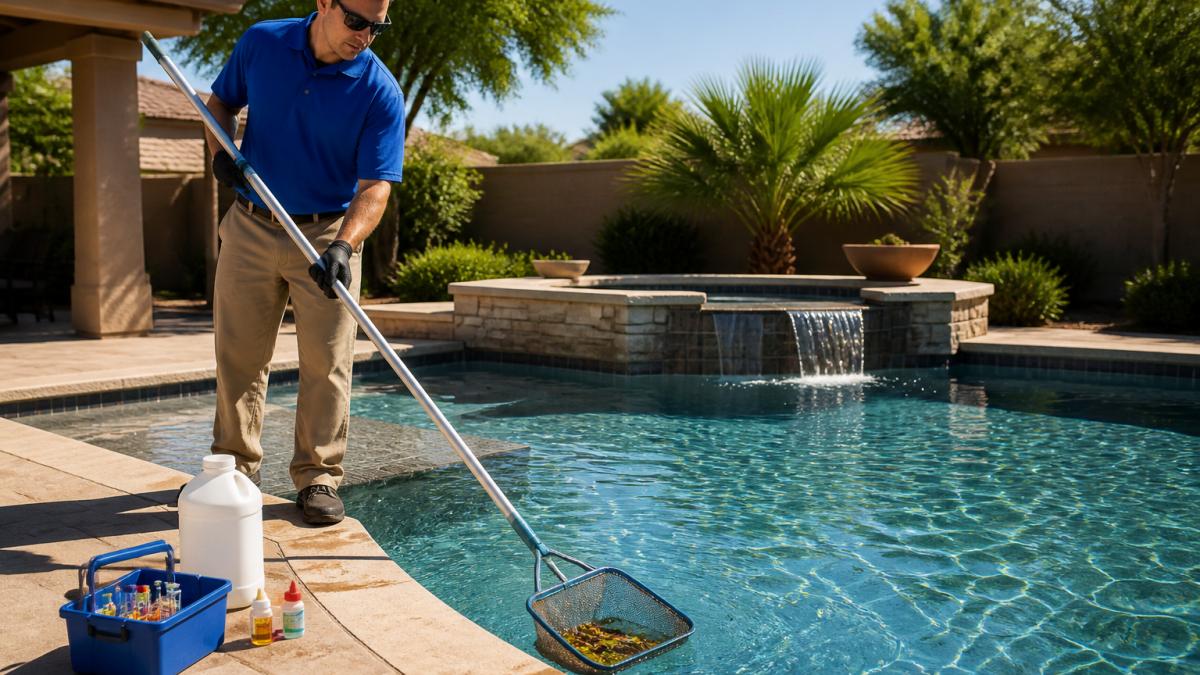
- Water chemistry tested and results recorded
- Surface debris skimmed
- Walls and tile line brushed
Ask any provider to walk you through their visit checklist before you hire them. The ones who have one ready are the ones who follow it.
Red Flags, Contracts, and Service Accountability
Service accountability is where most pool service relationships break down, and it's almost always a contract problem rather than a competence problem. Read the cancellation terms, price-increase clause, and satisfaction language before signing. Red flags: no written contract, cash-only payment with no invoice, refusal to provide an insurance certificate, unnamed or unchecked technicians, and "lifetime" promises with no defined remedy.
Documents to request before you sign
Ask for these in writing (email is fine) and keep them on file:
- Certificate of insurance showing general liability coverage with visible effective dates. Call the insurer's number to confirm it's current, certificates can be altered.
- State contractor license or registration number, if required. Look it up on your state licensing board's website rather than trusting a screenshot.
- Business registration or LLC filing confirming the entity you are contracting with matches the name on the quote.
Requirements vary by state and locality, so confirm what applies where you live before you treat a missing license as disqualifying, but a provider who cannot produce an insurance certificate on request is a hard stop almost everywhere.
Contract clauses that decide who pays when something goes wrong
A fair contract states the service frequency, what's included, how repairs are quoted, and what happens if you're unhappy. Read these clauses line by line:
- Scope and exclusions. What is explicitly not covered (e.g., filter media replacement, heater repair, leak detection)?
- Price-increase clause. How much notice, how often, and capped at what?
- Cancellation and auto-renewal. What is the notice window, and are there early-termination fees?
What a service report should contain
Accountability is only possible if each visit is documented. A useful service report includes date and time in/out, technician name, water chemistry readings (free chlorine, pH, total alkalinity, cyanuric acid, and salt if applicable), tasks completed, chemicals added with quantities, filter pressure, and any equipment issues with a photo. If a provider can't show a sample report, ask how you'd prove a visit happened.
How to handle missed visits and recurring problems
A common pattern is a missed visit nobody notices until the water turns. Protect yourself: (1) require a service report or photo after every visit, (2) keep a log of readings to spot trends before an algae bloom, (3) report problems in writing the same day, and (4) reference the satisfaction clause.
If a company can't articulate its satisfaction policy in one sentence, that's your answer.
Get a Free Quote and Lock In Your Service Schedule
The gap between a well-run pool and a neglected one usually comes down to consistency, not luck. Research and Markets projects the pool cleaning and maintenance services market growing from USD 28.79 billion in 2026 to USD 38.4 billion by 2030, and much of that growth is homeowners deciding they'd rather not spend Saturdays testing chlorine. We serve residential and commercial clients. Get a free quote and lock in a service schedule that keeps your water swim-ready year-round.
Frequently Asked Questions
How do I find and hire a reliable pool cleaning company?
Start with referrals from neighbors and local pool-supply stores, then check customer reviews across more than one platform. Confirm the company is licensed and insured, ask for a written service scope, and request a free quote before committing. A reliable pool cleaning company will show you exactly what each visit includes, how often it comes, and how it handles problems between visits. Get everything in writing, including cancellation terms, so expectations match on both sides.
What questions should I ask a pool cleaning company before hiring?
Ask what tasks each visit covers (skimming, brushing, vacuuming, basket emptying, water testing, chemical balancing, and equipment inspection), how often a technician comes, and whether chemicals are included in the quote. Also ask about licensing and insurance, who actually performs the work, how scheduling changes are handled, and what the satisfaction guarantee covers. These questions to ask a pool cleaning company reveal whether the service is a full maintenance program or a quick skim-and-go.
How much does professional pool cleaning cost?
Pool service cost depends on pool size, type (saltwater, vinyl liner, in-ground), service frequency, and whether chemicals are bundled into the plan. A weekly pool cleaning service typically costs more per month than a one-time visit because it includes ongoing chemical balancing and equipment checks. Because pricing varies by provider and property, request a free quote with an itemized breakdown so you can compare apples to apples rather than headline numbers.
Is it better to hire a pool maintenance professional or clean the pool myself?
DIY maintenance can work for a diligent pool owner with time for weekly skimming, brushing, water testing, and chemical adjustments. A pool maintenance professional earns the fee when you travel, work long hours, or want consistent water quality without learning chemical balance. Professionals also spot equipment problems early, which protects newer equipment and surfaces. If your pool sits neglected for weeks at a time, recurring service usually costs less than fixing the fallout.
What should be on a pool cleaning checklist for each visit?
A solid pool cleaning checklist covers skimming debris, brushing walls and surfaces, vacuuming the floor, emptying skimmer and pump baskets, testing water quality, balancing chemicals, and inspecting pool equipment for wear. Ask your provider to confirm which of these are included every visit versus billed separately. Comparing the checklist against the service quote shows whether you are paying for professional cleaning or just debris removal.
What does a satisfaction guarantee usually mean for pool service?
A satisfaction guarantee should state in writing what happens if you are unhappy with a visit, whether that means a return trip, a correction, or a refund. Ask for the specific terms before signing: how to report a problem, how quickly the company responds, and what is excluded. A clear guarantee is a sign of service accountability; a vague one is a red flag. Get the guarantee language in the contract, not just on a website.