 ultimate-guide
Professional Exterior Property Maintenance Services Guide
Table of Contents
- What Professional Exterior Property Maintenance Services Actually Cover
- Types of Exterior Maintenance Services and What They Cost
- How to Choose a Property Maintenance Company
- Commercial Exterior Maintenance Checklist for Property Managers
- What Does Satisfaction Guarantee Mean in Property Maintenance?
- Preventative Maintenance Schedules That Protect Property Value
- Conclusion: Getting Exterior Property Maintenance Right
- Frequently Asked Questions
Last Updated: October 7, 2026
What Professional Exterior Property Maintenance Services Actually Cover
Professional exterior property maintenance services cover the recurring work that keeps a building's outside surfaces clean, sealed, and structurally sound, from window cleaning and pressure washing to paver sealing and pool care. At Task Genie, we treat exterior property maintenance as a system rather than a list of one-off chores.
A common mistake is hiring a different specialist for every surface and assuming the results add up.
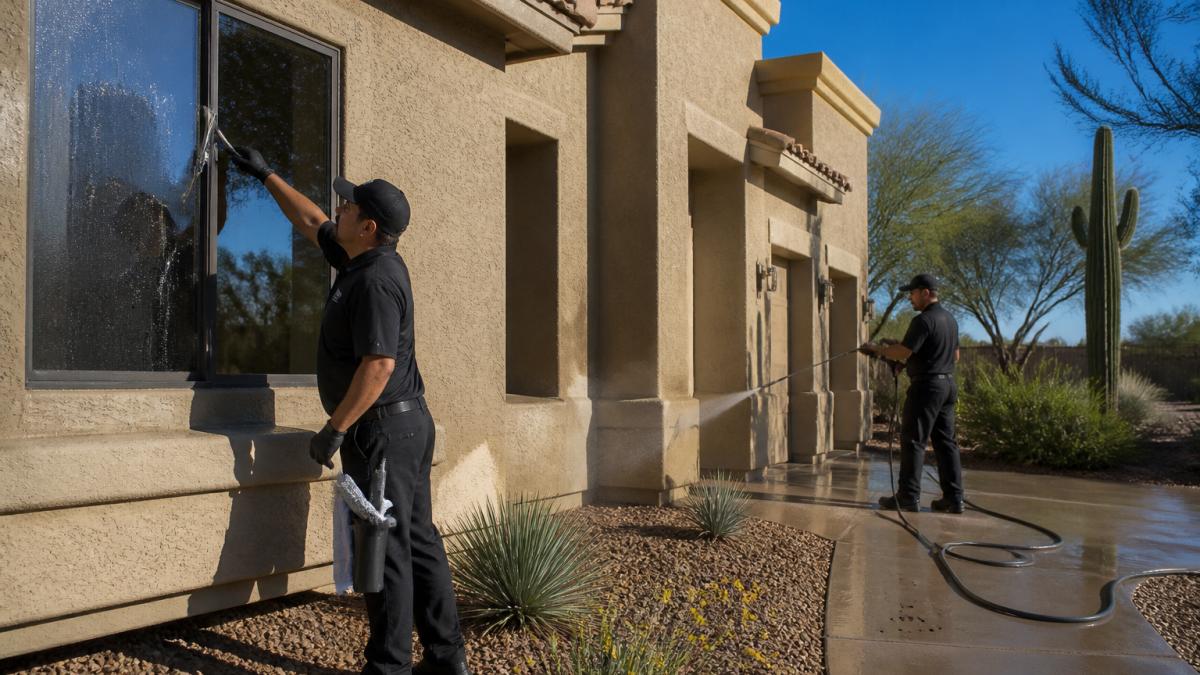
Here's what a complete exterior program actually includes:
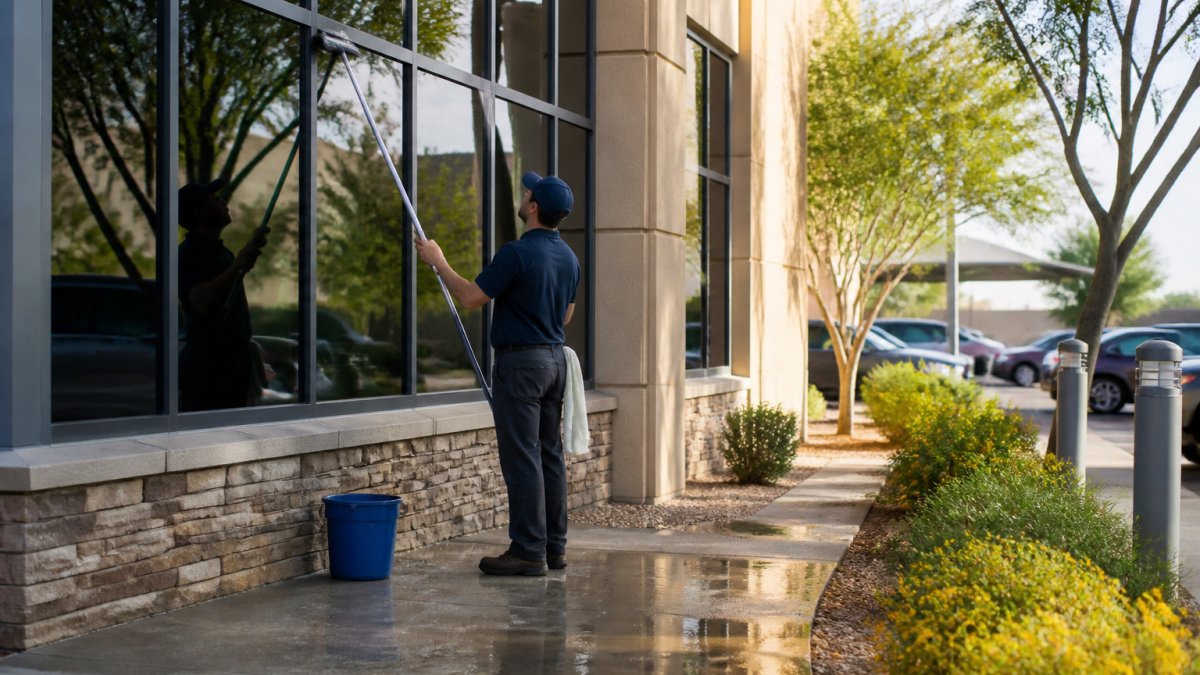
- Glass and frames: window cleaning, screen washing, and hard-water spot removal
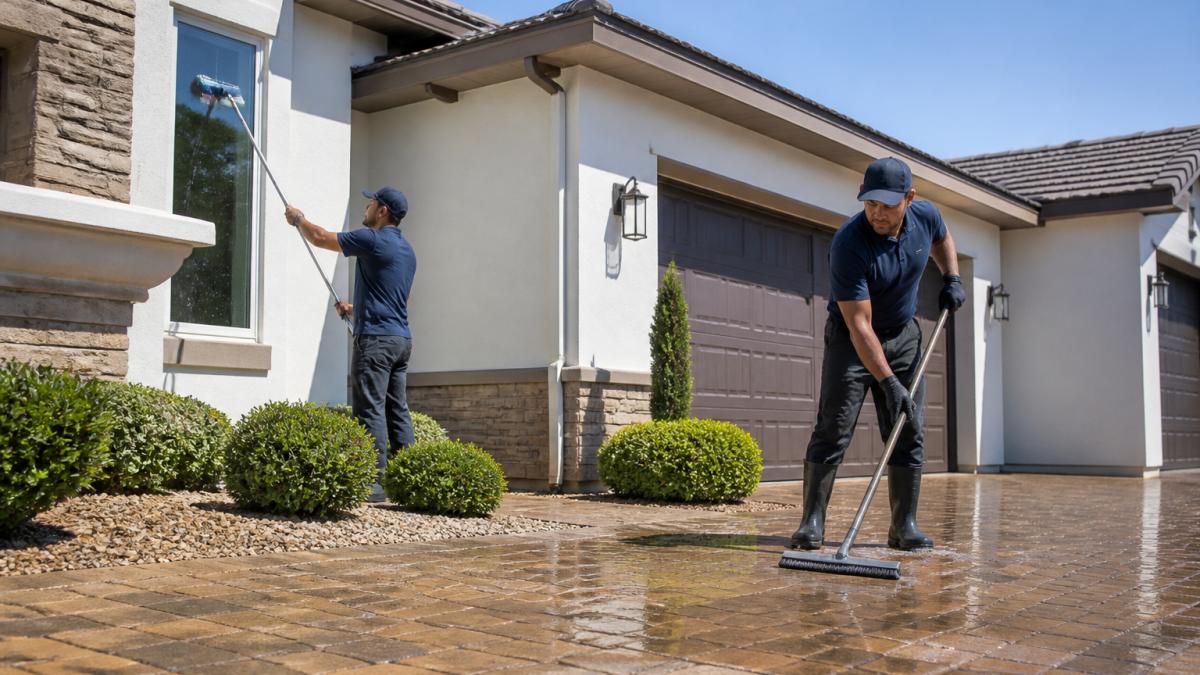
- Hardscape: pressure washing, paver sealing, and concrete cleaning
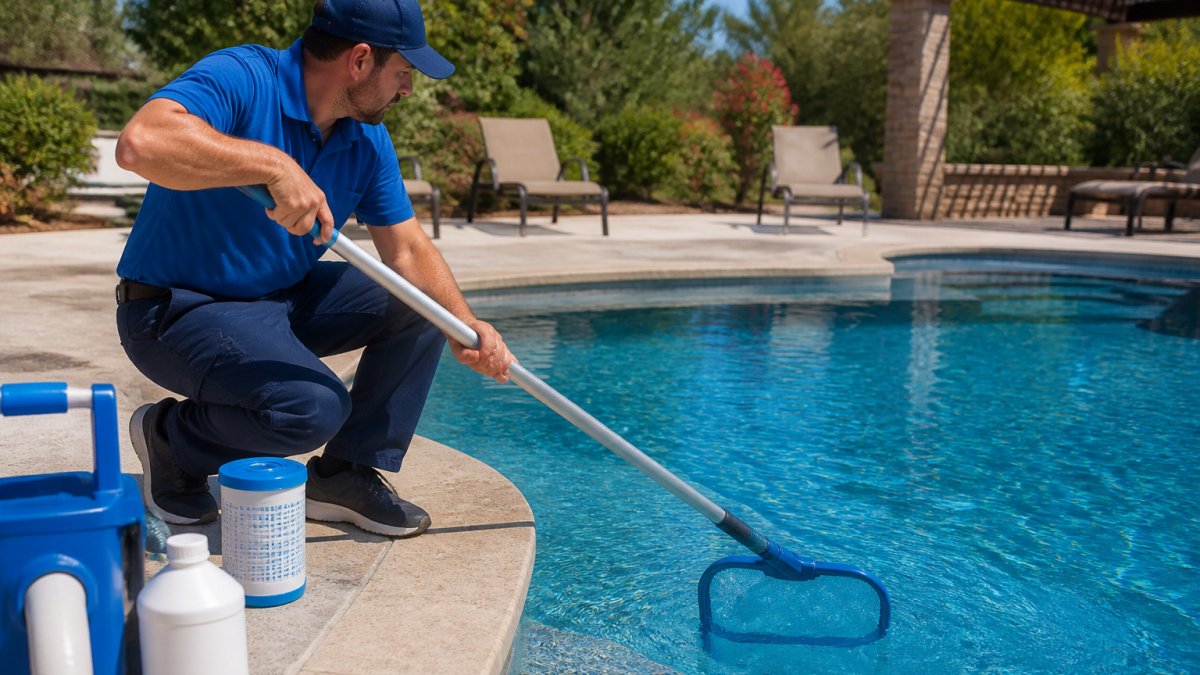
- Water features: pool maintenance, tile line cleaning, and chemical balancing
The real value is in sequencing those tasks so each one protects the next.
Types of Exterior Maintenance Services and What They Cost
Pricing for exterior property maintenance depends on square footage, surface condition, frequency, and access, so any quote you see online without an on-site assessment is a guess. Below is how each service is typically scoped and what drives the price up or down.
Window Cleaning and Exterior Surface Care
Window cleaning covers interior and exterior glass, screens, tracks, and frames, plus the hard-water mineral deposits common on west-facing windows. Purified water systems and proper squeegee technique prevent the streaking that do-it-yourself cleaning leaves behind.
Cost drivers for glass work:
- Pane count and height. Ground-floor windows are priced per pane; anything above the first story adds ladder, pole, or lift time.
- Hard-water and mineral removal. These deposits require a separate acidic or abrasive process and are quoted as an add-on, not included in a standard wash.
- Screen and track cleaning. Often billed per screen because it is hand work, not spray work.
- Frequency. Recurring quarterly service is almost always priced lower per visit than a one-time clean, because the crew spends less time on buildup.
Paver Sealing, Pressure Washing, and Pool Maintenance
Paver sealing protects the investment in a driveway, patio, or pool deck by blocking stains and locking in joint sand. Heavily neglected surfaces may need a deep clean first, and results depend on how much of the original color remains.
Cost drivers for hardscape work:
- Square footage. This is the primary multiplier for both washing and sealing.
- Surface type. Concrete, pavers, travertine, and flagstone each require different pressure, nozzles, and chemicals.
- Joint sand replacement. If the joints are depleted, new polymeric sand is a separate line item before sealing.
- Sealer type. Film-forming sealers and penetrating sealers carry different material costs and different reapplication intervals.
Pool maintenance keeps water balanced and swim-ready year-round, which in this climate means more frequent attention during summer. Pressure washing handles concrete, walkways, and retaining walls.
| Service | What It Protects | Typical Frequency | Primary Cost Driver |
|---|---|---|---|
| Window cleaning | Glass clarity, frames, screens | Quarterly to twice yearly | Pane count and height |
| Pressure washing | Concrete, walkways, walls | Annually, or before sealing | Square footage and surface type |
| Paver sealing | Joint sand, color, stain resistance | Every 2-3 years | Square footage and joint condition |
| Pool maintenance | Water balance, equipment, tile | Weekly in season | Pool size and service tier |
| Gutter cleaning | Roof edge, foundation drainage | Twice yearly | Linear feet and roof pitch |
How to Read a Quote Before You Sign
A written scope should name the surfaces, the products, and the frequency. If a provider quotes a number before looking at the property, that number will change. Confirm three things in writing:
- What is excluded. Most quotes cover the visible surfaces and exclude mineral removal, joint sand, or screen tracks unless listed.
- What triggers a change order. If the crew finds rot, failed sealant, or a cracked paver, who approves the added work?
- What the reapplication interval is. A sealer quoted at a low price may need reapplication twice as often, which changes the true annual cost.
How to Choose a Property Maintenance Company
Choosing a property maintenance company comes down to four checks: licensing and insurance, a written scope of work, verifiable customer reviews, and a satisfaction guarantee with readable terms.
Ask for the certificate of insurance before work begins.
Then run this checklist before you sign anything:
- Confirm the business is licensed and insured, and request documentation
- Get the scope in writing, listing each surface and product
- Ask how scheduling works if you are not home to approve the work
- Read the satisfaction guarantee and understand what triggers a redo
- Check customer reviews for reliability, not just quality of results
- Confirm who handles damage if something breaks during service
A provider with excellent workmanship and inconsistent arrival times will still leave you managing the schedule you hired them to remove.
Commercial Exterior Maintenance Checklist for Property Managers
A commercial exterior maintenance checklist should be organized by frequency, not by trade.
For commercial building maintenance, first impressions drive leasing decisions.
Quarterly:
- Window cleaning on all customer-facing glass
- Pressure washing of entryways, walkways, and dumpster pads
- Site inspection of the building envelope, sealants, and drainage
Semi-annually:
- Gutter cleaning and roof washing
- Parking lot sweeping and striping assessment
- Landscape and groundskeeping review
Annually:
- Concrete sealing and paver sealing
- Exterior painting touch-ups
- Full property condition report for budgeting
Facility management platforms such as Breezeway's property operations tools help teams automate recurring task scheduling and capture photo documentation from the field, which simplifies vendor accountability across a portfolio.
OSHA guidance on walking-working surfaces is worth reviewing before any pressure washing or roof-adjacent work, since fall protection requirements apply to exterior crews as much as to any other trade.
What Does Satisfaction Guarantee Mean in Property Maintenance?
A satisfaction guarantee in property maintenance means the provider commits to correcting work you are not happy with, usually by returning to redo the affected area at no additional cost. It is a service remedy, not automatically a refund.
"Guaranteed" does not always mean money back. Read what the guarantee actually promises: a return visit, a partial credit, or a full refund. Each is legitimate, but they are not the same thing.
The Vetting Checklist Most Guides Skip
A guarantee is only as strong as the business behind it. Before you compare guarantees, confirm the provider can legally stand behind the work:
- State or local business license. Ask for the license number and verify it with the issuing authority, not just the number on the invoice.
- General liability insurance. Request a certificate of insurance (COI) naming the coverage limits and effective dates. Call the insurer to confirm it is active.
- Workers' compensation coverage. If a crew member is injured on your property and the company carries no workers' comp, the claim can follow the property owner.
- Surety bond, where required. Some jurisdictions require a bond for certain exterior trades. Confirm whether yours does.
- Written scope of work. Every surface, product, and frequency listed in writing before work begins.
- Payment terms. Deposits, progress payments, and final payment tied to completion, not to a calendar date.
- Certificate of insurance for subcontractors. If the provider subs out roof or pool work, those subs need their own coverage.
The insurance and licensing check is the step property owners skip, and it creates the largest liability exposure.
What to Ask About the Guarantee Itself
Once the business checks out, evaluate the guarantee on its terms:
- What is the time window for reporting an issue? A guarantee that expires in 24 hours is not a guarantee.
- Does it cover labor only, or materials too? A redo that requires new sealer or new joint sand may be billed back to you.
- Who decides whether the work meets standard? If the answer is only the provider, the guarantee is weaker than it sounds.
- Is the guarantee transferable? For commercial properties and rental portfolios, a transferable guarantee has value at sale or lease turnover.
- Is it in the contract? Verbal promises about "coming back if you're not happy" mean nothing without written terms.
Preventative Maintenance Schedules That Protect Property Value
A preventative maintenance schedule is a calendar of recurring exterior tasks timed to your property's materials and your local climate. Routine maintenance prevents small failures from compounding into structural repairs.
Property value responds to this directly. Curb appeal influences buyer perception before a single interior door opens, and a documented maintenance history signals a well-cared-for property. The EPA's guidance on water efficiency and outdoor use is a useful reference for pool and irrigation scheduling in arid regions, where evaporation losses drive up both water bills and chemical costs.
Build the schedule around seasons rather than intentions:
| Season | Priority Tasks | Why It Matters |
|---|---|---|
| Spring | Pressure washing, gutter cleaning, pool opening | Removes winter buildup before summer sun bakes it in |
| Summer | Pool maintenance, window cleaning, irrigation checks | Peak heat stresses water features and glass |
| Fall | Paver sealing, exterior painting, roof washing | Sealing before winter locks out moisture |
| Winter | Site inspections, equipment service, planning | Low season for repairs and budgeting |
Conclusion: Getting Exterior Property Maintenance Right
The hard part of exterior property maintenance is not finding someone to wash a window. It is finding a provider who shows up on schedule, documents the work, and stands behind it.
Task Genie handles all three. We are locally owned and operated in Buckeye, we serve both residential and commercial clients, and we use professional-grade equipment and premium products on every job.
Get a free quote from Task Genie and hand off the exterior upkeep, so your property stays sharp without costing you a Saturday.
Frequently Asked Questions
What is included in exterior property maintenance?
Professional exterior property maintenance typically covers window cleaning, pressure washing, paver sealing, and pool care. The exact scope depends on your property type and service provider. A comprehensive maintenance plan addresses all exterior surfaces, from the building envelope to hardscapes, so nothing deteriorates from neglect. Ask each provider for a written scope of work before signing anything, and confirm which tasks are recurring versus one-time.
How often should you schedule professional exterior maintenance?
Most properties benefit from quarterly or bi-annual exterior maintenance, with pressure washing and window cleaning every 3 to 6 months. Pool maintenance requires weekly or bi-weekly service. Paver sealing typically lasts 2 to 3 years before reapplication. Seasonal maintenance in spring and fall catches damage before it worsens. A preventative maintenance schedule tailored to your property's materials and local climate will keep exterior surfaces protected year-round and reduce costly repairs.
How do you evaluate the quality of exterior property maintenance companies?
Check for licensing and insurance, read customer reviews on multiple platforms, and ask for references from properties similar to yours. Look at whether the company uses professional-grade equipment and premium products, and confirm they carry a satisfaction guarantee. Ask how they handle scheduling, whether you need to be home, and what happens if you are not happy with the work. A company that answers these questions clearly and provides a written service quote is worth considering.
What does a satisfaction guarantee mean in property maintenance?
A satisfaction guarantee means the company will redo the work or refund your payment if the results do not meet the agreed standard. The specifics vary: some guarantees cover a set number of days after service, others require you to report issues within a window. Ask what triggers the guarantee, what remedies are offered, and whether there are exclusions. A 100% satisfaction guarantee should be stated in writing and explained before you book.