 ultimate-guide
Commercial Property Exterior Maintenance Checklist Guide
Last Updated: October 28, 2026
Quick Summary
A commercial exterior maintenance checklist covers the building envelope, roof, drainage, grounds, paved surfaces and site features, with inspections scheduled monthly, quarterly, semiannually, annually and after storms. Each finding is recorded with photos and assigned a priority level so that urgent problems are escalated and routine items are scheduled.
- Walk the roof perimeter and check every flashing and penetration seal each quarter.
- Clean gutters and downspouts at least twice a year, more often under trees.
- Ponding water on flat roofs should drain within about 48 hours after rain.
- Run each irrigation zone manually at least monthly during the growing season.
- Priority 1 issues such as active leaks or exposed wiring are escalated the same day.
Table of Contents
- Why a Commercial Exterior Maintenance Checklist Matters
- Building Envelope and Roof Inspection Checklist
- Commercial Landscape Maintenance Checklist
- Commercial Spring Maintenance Checklist for Seasonal Damage
- Commercial Property Inspection Checklist and Documentation Workflow
- Setting Task Frequency, Priority Levels, and Escalation Criteria
- Scheduling Your First Exterior Walkthrough With Task Genie
- Frequently Asked Questions
Why a Commercial Exterior Maintenance Checklist Matters
A written exterior maintenance checklist turns that unpredictable wear into a schedule you can actually manage.
Think of the checklist as the operating baseline for the building envelope, grounds, and common areas. It does not replace a licensed roofer or structural engineer for major problems, but it tells you when to call one.
Building Envelope and Roof Inspection Checklist
The building envelope is everything that separates the interior from the weather: roof, walls, windows, doors, and the joints between them. Inspect it on a fixed schedule, typically once per season and after any severe storm, and log what you find with photos.
Roof coverings, flashings, and penetrations
Start with the roof covering itself. Look for cracked, blistered, lifted, or missing material, and for granule loss on asphalt shingles or membrane splits on flat roofs. Walk the perimeter where the access is safe, and use binoculars from the ground if it is not.
Next, check the flashings, the metal or membrane pieces sealing transitions at walls, parapets, curbs, and roof edges. Look for gaps, lifted edges, and sealant that has dried out or pulled away.
Finally, inspect every roof penetration, including vents, pipes, exhaust fans, and HVAC curbs. Confirm each seal is intact and that no penetration is pooling water around its base.
- Walk the roof perimeter and note any cracked, lifted, or missing covering.
- Check every flashing for gaps, lifted edges, and failed sealant.
- Inspect each penetration seal and clear any debris collecting around it.
- Photograph anything questionable and record the location on the building map.
Gutters, downspouts, and drainage
Drainage belongs on every checklist. Clean gutters and downspouts at least twice a year, and more often under trees. Confirm each downspout discharges well away from the building and that splash blocks or extensions are in place.
Watch for ponding water on flat roofs, which should drain within about 48 hours after rain. Standing water that lingers longer should be investigated promptly.
Check grading around the foundation as well. Soil should slope away from the building, and any low spot that holds water should be regraded or filled.
Commercial Landscape Maintenance Checklist
Treat grounds maintenance as its own checklist, run on a regular cycle, and organize it by component so nothing gets skipped.
Irrigation and water management
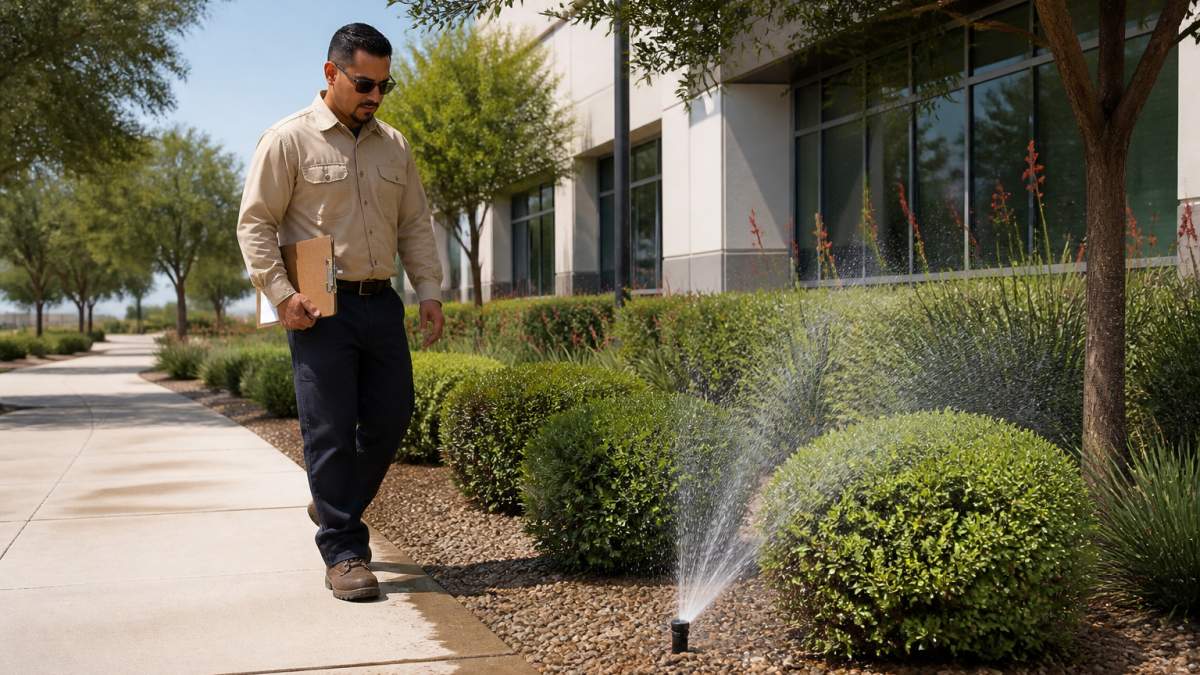
Inspect irrigation zones at least monthly during the growing season and after any controller or valve work. Run each zone manually and look for broken or clogged spray heads, misaligned heads that water pavement or building walls, leaks at valves and backflow assemblies, and low-head drainage at the lowest emitter.
Check the controller schedule against local watering restrictions and adjust for rainfall. Confirm rain sensors and soil-moisture sensors are working, and verify that backflow preventers have been tested per the local water authority's requirements. In freezing climates, blow out irrigation lines before the first hard freeze and restart them only after the threat of frost has passed.
Turf, plantings, and trees
Mow turf to the height appropriate for the species and season, and keep clippings off paved surfaces and out of drains. Aerate and overseed cool-season turf in early fall and warm-season turf in late spring to early summer, and fertilize according to a soil test rather than a calendar guess.
Trim plantings away from walls, windows, lighting, signage, and roof lines. Remove dead, diseased, or hazardous limbs, especially those overhanging walkways, parking areas, and roofs. Have large or high-risk trees assessed by a certified arborist rather than trimmed by general staff.
Paved surfaces, walkways, and parking areas
Walk paved walkways and parking areas and note cracks, heaves from roots, loose pavers, settled utility cuts, and faded or missing striping. Paved surfaces, including commercial paver installations, can be included in a maintenance checklist. Commercial paver sealing services cover the care and sealing these surfaces need. Ask a local paver contractor for a condition assessment rather than guessing.
Sweep or power-blow paved areas and storm inlets so debris does not reach drains. Check that accessible routes remain clear, that curb ramps are intact, and that detectable warning surfaces at ramps are not worn or obstructed. Repair trip hazards promptly and document the repair.
Site features, lighting, and safety
Check exterior lighting, bollards, signage, fences, and gates on the same cycle as the grounds walk. Confirm that parking-lot light levels are adequate, that photocells and timers work, and that no fixture is damaged or leaning. Verify that fire lanes, hydrants, and utility vaults are visible and unobstructed.
Remove leaves and debris from paved areas and drains so water keeps moving where it should. Inspect trash enclosures and dumpster pads for spills, pests, and damage, and confirm that lids and gates close properly. Keep a simple grounds log with dates, findings, and photos so seasonal patterns and recurring problems are easy to spot.
Commercial Spring Maintenance Checklist for Seasonal Damage
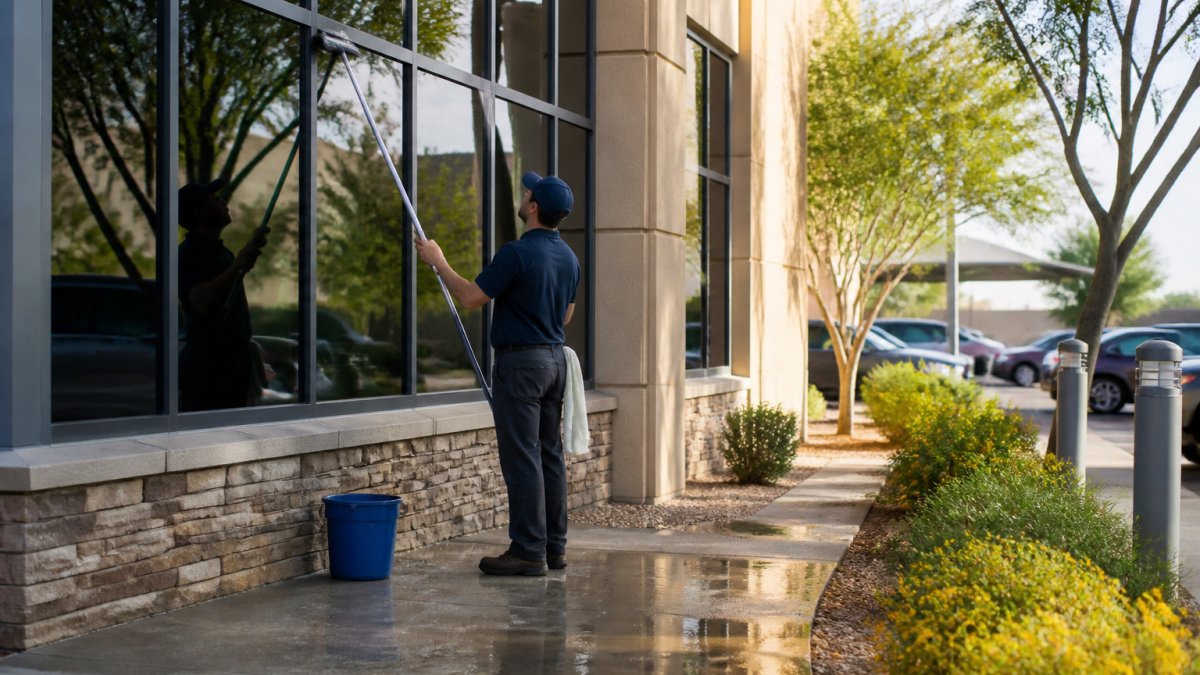
Begin with a full envelope walk: roof, flashings, gutters, and exterior walls. Learn how commercial window cleaning fits into the exterior upkeep plan. Look for cracks, loose fasteners, and damage from ice or falling branches. Repair what is safe to repair and document anything that needs a specialist.
Then move to grounds. Reactivate and test the irrigation system, reseed or re-sod thin turf, and check for dead plant material. Power wash or inspect walkways and building exteriors where grime or biological growth has built up over winter. Finish by confirming exterior lighting works.
Commercial Property Inspection Checklist and Documentation Workflow
A checklist only works if the results are recorded and acted on. Use a standard inspection form for every walk, covering each building component in the same order so inspections are comparable from one season to the next.
For each item, record the condition (good, monitor, or action needed), the date, the inspector's name, and photos of anything flagged. Store records in one central location so the history of each component is easy to pull up before the next inspection.
Turn every "action needed" finding into a work order with an owner and a target date.
Setting Task Frequency, Priority Levels, and Escalation Criteria
Not every exterior task needs the same attention, so assign each one a frequency and a priority. The most useful format is a frequency matrix that lists each building component against monthly, quarterly, semiannual, annual, and post-storm checks. That single table turns a long checklist into a schedule staff can actually run.
A practical frequency matrix
Use the following cadence as a starting point and adjust for climate, building age, and site exposure:
- Monthly: irrigation zone run-through during the growing season, exterior lighting and signage check, walkway and parking-area trip-hazard sweep, trash-enclosure inspection, drain inlet clearing.
- Quarterly: gutter and downspout inspection (cleaning as needed), roof perimeter and flashing walk, sealant and caulk review at windows and doors, parking-lot striping and bollard check, fence and gate inspection.
- Semiannual: full roof inspection, complete envelope walk, gutter cleaning, landscape bed refresh, exterior painting and coating condition review.
- Annual: roof membrane or shingle condition assessment, facade and masonry inspection, parking-lot sealcoat and restripe planning, irrigation backflow testing, tree risk assessment by a certified arborist.
- Post-storm or post-event: roof, flashing, gutters, downspouts, signage, lighting, trees, and paved surfaces after any severe wind, hail, freeze, or heavy-rain event.
Set frequencies based on how fast each component deteriorates and how exposed it is to weather.
Three priority levels
Use three priority levels to decide how quickly to act, and write the definitions down so every inspector applies them the same way.
- Priority 1, Immediate: active water intrusion, exposed electrical components, structural movement, a fall hazard on a high-traffic route, or anything that blocks an accessible route or fire lane. Escalate the same day.
- Priority 2, Scheduled: degrading conditions that are not yet dangerous, such as a cracked sealant joint, a slow drain, or a worn stair nosing. Schedule within a set window, often 30 days.
- Priority 3, Routine: cosmetic or long-horizon items such as faded paint, minor landscaping gaps, or a burned-out decorative fixture. Fold into the next scheduled visit or budget cycle.
Escalation criteria and who to call
Define escalation criteria in advance so staff know when to call for help rather than improvise. Common triggers include active leaks into occupied space, visible structural movement or spalling, exposed wiring or damaged panels, trip hazards on high-traffic walkways, damaged handrails or guardrails, and any damage that could affect a tenant's safe access to the building.
Route each trigger to the right party: the building owner or asset manager for budget decisions, a licensed roofing or envelope contractor for water intrusion, a structural engineer for movement or spalling, a certified arborist for tree risk, and the local code authority when a condition may affect compliance.
From findings to budget and lifecycle planning
A frequency matrix is also a budgeting tool. Roll Priority 2 and Priority 3 findings into a rolling 12-month plan and compare them against reserve balances and capital plans. When a component repeatedly generates Priority 2 findings, that pattern is a signal to evaluate repair versus replacement rather than continuing to patch. Documenting the pattern over two or three cycles gives owners a defensible basis for lifecycle decisions without relying on guesswork about costs.
The article sets out a frequency cadence and three priority levels for exterior tasks, summarised below.
| Frequency | Example tasks |
|---|---|
| Monthly | Irrigation run-through, lighting and signage check, trip-hazard sweep, drain clearing |
| Quarterly | Gutter inspection, roof perimeter and flashing walk, sealant review, striping and bollard check |
| Semiannual | Full roof inspection, complete envelope walk, gutter cleaning, coating review |
| Annual | Roof assessment, facade inspection, sealcoat planning, backflow testing, tree risk assessment |
| Post-storm | Roof, flashings, gutters, signage, lighting, trees and paved surfaces after severe weather |
Scheduling Your First Exterior Walkthrough With Task Genie
If you manage exterior maintenance in-house, the checklist above gives you a working system. Task Genie, a locally owned property care company in Buckeye, AZ, serves both residential and commercial clients. We serve both residential and commercial clients, with professional window cleaning, paver sealing, and pool maintenance, and we back our work with a 100% satisfaction guarantee.
You can review our services on our Our Services page, and when you are ready to move forward, request a free quote.
Frequently Asked Questions
What should be included in a commercial property exterior maintenance checklist?
A useful checklist covers the building envelope, roof coverings, flashings, roof penetrations, gutters, downspouts, drainage systems, walkways, stairways, exterior lighting, painting and caulking, landscaping, and irrigation. Organize each item by building component so inspectors can move around the property in a logical route. Record the condition, the date, and any action taken, so the checklist also serves as a maintenance record for property managers and owners.
How often should a commercial building exterior be inspected?
Inspection schedules can reflect the building's actual exposure.
What exterior maintenance should be done seasonally?
A seasonal checklist can cover gutters and drains, irrigation, walkways, roof edges, signage, and landscaping.
How do you create a preventive maintenance schedule for a commercial property?
Start with an inventory of exterior assets, then assign each one a task, a frequency, and a priority level. Group tasks by season, and log completed items.
What should a commercial property manager check on the roof and gutters?
Check roof coverings for surface damage, blistering, or loose materials, and inspect flashings and roof penetrations for gaps or deterioration. Look for ponding water that persists after rain. On gutters and downspouts, check for blockages, separated seams, and sections pulling away from the building, and confirm that water drains away from the foundation.
How do you maintain commercial landscaping and hardscaping?
Maintain turf, plantings, and irrigation on a regular schedule, and inspect spray heads and drip lines for clogs and breaks. Check walkways and stairways for trip hazards, cracks, and standing water.
When should commercial windows be professionally cleaned?
Exterior windows on commercial buildings can be included in a maintenance checklist.
What exterior maintenance issues should be addressed immediately?
A checklist can record water intrusion, roof damage, blocked drains, walkway or stairway damage, and exterior lighting failures. Document each issue with photos and the date found.